
Placement Eligibility Calculator
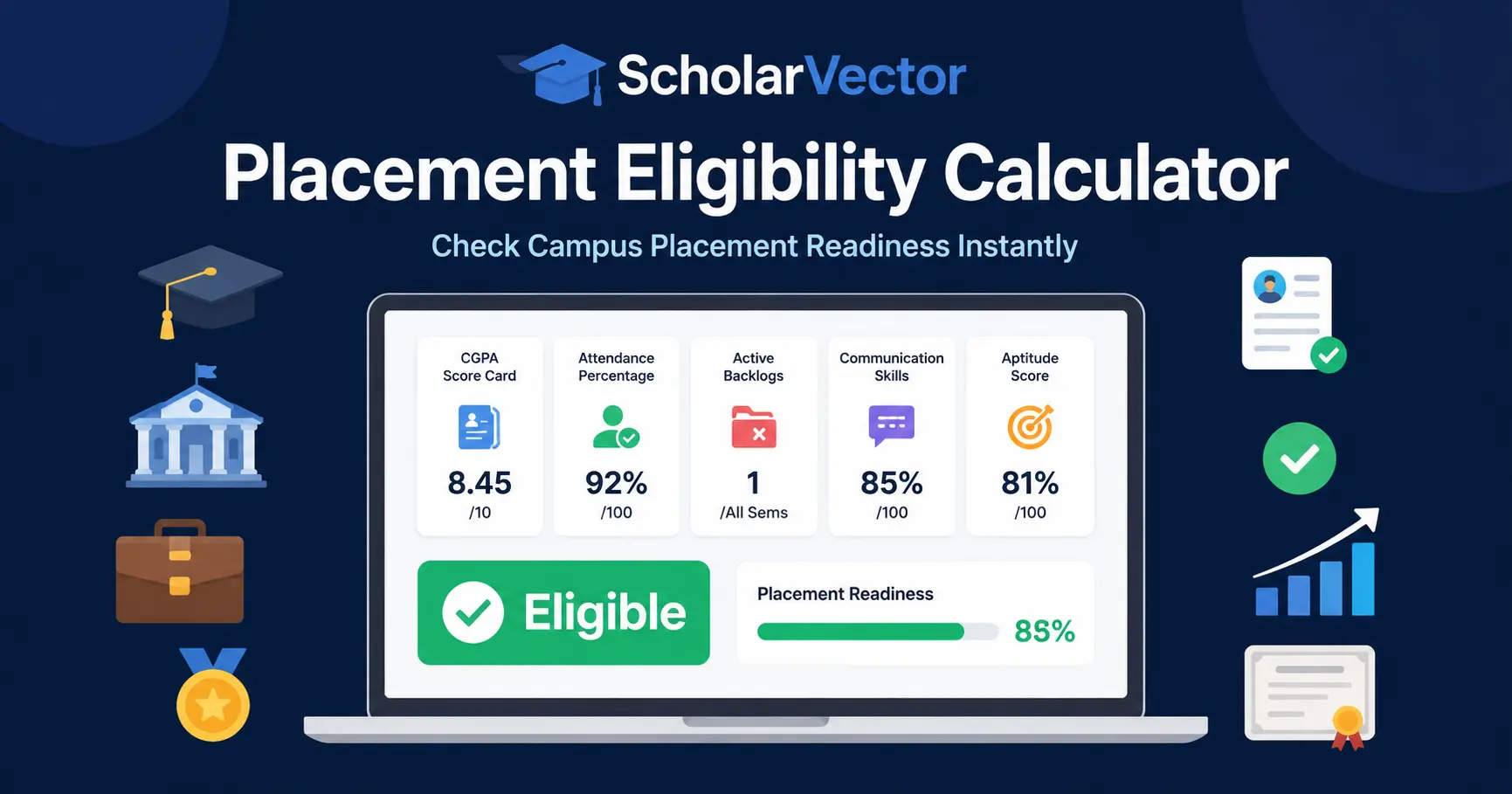
Check whether you qualify for campus placements. Enter your CGPA, backlogs, attendance and skills to get a Placement Readiness Index, an eligibility checklist, company-wise match and a personalized action plan.
—
| Criterion | Required | Your value | Status |
|---|
The Placement Readiness Index (PRI) is a single score from 0 to 100 that blends three independent dimensions of your profile. Each dimension carries a fixed weight based on how much recruiters typically rely on it during campus hiring. Rather than treating every input equally, the calculator gives more importance to the factors that most often decide whether a student clears the first eligibility filter.
The three weighted components are combined as: PRI = (Academic × 45%) + (Skills × 35%) + (Backlog Health × 20%). Every component is first normalized to a 0–100 scale, then multiplied by its weight and summed, so the final index stays easy to interpret.
- CGPA
- Degree %
- 10th %
- 12th %
- Attendance
- Programming
- Communication
- Aptitude
- Active Backlogs
- History Backlogs
| Component | Weight | Factors included |
|---|---|---|
| Academic Performance | 45% | CGPA, Degree %, 10th %, 12th %, Attendance |
| Skills | 35% | Programming, Communication, Aptitude |
| Backlog Health | 20% | Active Backlogs, History Backlogs |
Learn more about how ScholarVector develops and verifies its calculators: Methodology →
The score is built in stages. Each of your inputs is converted to a common 0–100 scale first, so a CGPA on a 10-point scale and a percentage on a 100-point scale can be compared fairly before anything is weighted.
- Normalize academics. Your CGPA is converted to a percentage of your maximum scale, then combined with your 10th, 12th, degree % and attendance into a single Academic score out of 100.
- Score your skills. Your programming, communication and aptitude self-ratings (each 1–10) are averaged and scaled to a Skills score out of 100.
- Measure backlog health. Starting from a perfect 100, active backlogs reduce the score sharply and history backlogs reduce it slightly, producing a Backlog Health score.
- Apply the weights. The three scores are multiplied by 45%, 35% and 20% and added together to form your Placement Readiness Index.
- Check hard gates. Separately, your CGPA is compared against the company requirement and your active backlogs against the allowed limit. These act as pass/fail gates that shape the final verdict, independent of the overall index.
🎓 Why CGPA matters
It is the most-used first filter in campus hiring and a proxy for consistency, so it carries the largest single share of the academic weight.
⚠️ Why backlogs matter
Active backlogs are a common hard disqualifier. Even a strong profile can be blocked by a single unresolved backlog, so they can override a high score.
📅 Why attendance matters
Many colleges require a minimum attendance to let you sit for drives at all, so it forms part of the academic component and a checklist gate.
💡 Why skills matter
Aptitude, coding and communication decide the assessment and interview rounds that follow eligibility, so they carry a substantial weight of their own.
ScholarVector references publicly available educational information to shape the general thresholds and categories used in this calculator. These reference categories include, among others:
For complete transparency, please visit: Data Sources →
- This calculator provides estimates, not decisions.
- Results depend entirely on the inputs you provide — inaccurate inputs produce inaccurate estimates.
- Actual company requirements differ and are set by each recruiter.
- Universities may follow different regulations and cut-offs.
- Companies update eligibility criteria from season to season.
- The tool is intended for educational guidance only and does not promise or guarantee placement.
What is placement eligibility?
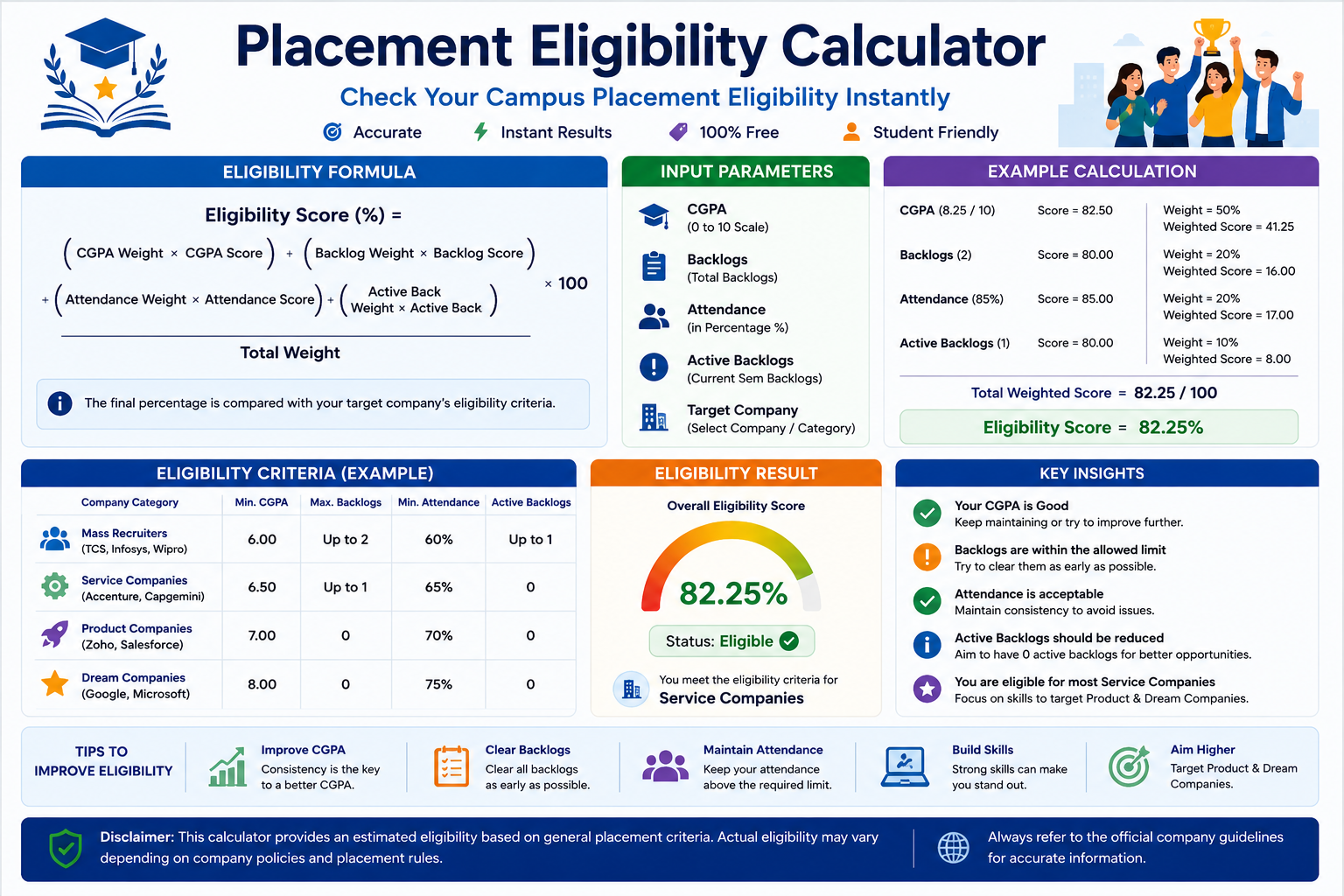
Placement eligibility is the set of academic and skill criteria a student must meet before a company allows them to sit for a campus placement drive. Every recruiter that visits an Indian college publishes conditions — a minimum CGPA, a cap on active backlogs, a required attendance level and sometimes a specific branch or gap-year rule. If you meet all of them, you are eligible to appear for selection. If you miss even one, your application is usually filtered out before the interview stage.
This is why understanding eligibility early matters. A brilliant coder with two active backlogs may never get a chance to prove their skills, while an average student with a clean record clears the first gate easily. The calculator above turns these scattered rules into a single, clear verdict.
How companies shortlist candidates
Campus recruitment follows a funnel. Thousands of applications narrow to a handful of offers through automated and human filters:
- Eligibility filter: The first, purely mechanical cut based on CGPA, backlogs, attendance and branch.
- Online assessment: Aptitude, logical reasoning, verbal ability and, for tech roles, coding problems.
- Technical rounds: Data structures, core subjects, projects and problem solving.
- HR and managerial rounds: Communication, attitude, culture fit and salary discussion.
The calculator focuses on the first filter, where most eligible-on-paper students lose out — not on skill, but on a number they overlooked.
Why CGPA matters
Your CGPA is the single most-used filter in campus placements. Recruiters treat it as a proxy for consistency and discipline. Typical expectations: mass recruiters at 6.0–6.5, mid-tier and analytics firms at 7.0–7.5, and top product companies at 8.0 and above. A higher CGPA widens the number of companies you can apply to — every extra tenth of a point can unlock another set of recruiters.
Why backlogs matter
There are two kinds. Active backlogs are subjects you have currently failed and not yet cleared. History backlogs are subjects you failed earlier but have since passed. Many companies demand zero active backlogs on the day of the drive. Clearing an active backlog should be your first priority — a single one can disqualify you from an entire season.
Placement criteria in Indian colleges
While every institution differs, most share a common core:
- A minimum aggregate CGPA or percentage in the ongoing degree.
- A minimum of 60% in both 10th and 12th for many companies.
- Zero active backlogs, with a cap on history backlogs.
- A minimum attendance, commonly 75%, to sit for drives.
- No unexplained education gap beyond a permitted limit.
Mass recruiters vs product companies
Mass recruiters — large IT services firms — hire in bulk with moderate CGPA cut-offs and standardized tests, making them a reliable safety net. Product companies hire fewer people, pay more, and expect a higher CGPA plus strong data structures, algorithms and real project experience. Knowing your target lets you invest time where it counts.
How to improve your placement chances
- Clear active backlogs immediately — the hardest disqualifier to remove.
- Protect and lift your CGPA every remaining semester.
- Practice aptitude daily for first-round tests.
- Build two or three solid projects you can explain end to end.
- Sharpen coding fundamentals for technical roles.
- Rehearse communication with weekly mock interviews.
- Keep attendance above the threshold so you are never blocked.
Common mistakes students make
- Ignoring backlogs until the season begins, when it is too late.
- Chasing only dream companies and skipping reliable mass recruiters.
- Letting attendance slip and getting blocked despite a good CGPA.
- Starting aptitude and coding practice only weeks before the first drive.
- A resume full of buzzwords but no projects they can explain.
- Not checking each company’s exact eligibility rules.
Why Trust ScholarVector?
ScholarVector builds student tools with transparency first. Here is what stands behind this calculator.
Transparent Methodology
Every weight and scoring rule is documented and explained openly above — nothing is hidden.
Verified Educational Logic
The scoring logic reflects common, publicly documented campus-placement criteria.
Educational Purpose
Designed to help students understand and improve their readiness, not to make hiring decisions.
Independent Platform
ScholarVector is independent and not affiliated with any company or university.
Free To Use
The calculator is completely free, runs in your browser, and stores none of your data.
Regular Updates
Content and criteria are reviewed and refreshed as placement norms evolve.
Official Educational Resources
ScholarVector develops educational calculators using transparent methodologies and publicly available academic information. To verify university regulations, technical education standards, and higher education policies, we recommend referring to these official educational authorities.
Note: This Placement Eligibility Calculator is intended for educational and planning purposes only. Campus placement eligibility varies by recruiter, university, academic regulations, and recruitment year. Always verify the latest eligibility criteria with your college placement cell and official recruitment notifications before making important academic decisions.
Frequently asked questions
What is a placement eligibility calculator?
What CGPA is required for campus placement in India?
Do active backlogs affect placement eligibility?
How is the Placement Readiness Index calculated?
Can I get placed with a low CGPA?
What is the difference between mass recruiters and product companies?
Is attendance considered for placement eligibility?
How accurate is this placement eligibility calculator?
When should I start preparing for placements?
Is this placement calculator free to use?
Disclaimer
This calculator provides estimates for guidance only and is not a guarantee of selection or rejection. Eligibility rules, CGPA cut-offs, backlog policies and attendance requirements are set independently by each company and institution and change frequently. Always confirm exact criteria with your placement cell and the recruiter. ScholarVector is an independent educational resource and is not affiliated with any company or university.